Welcome to my personal webpage

Hanqiong Jia

觀天習文

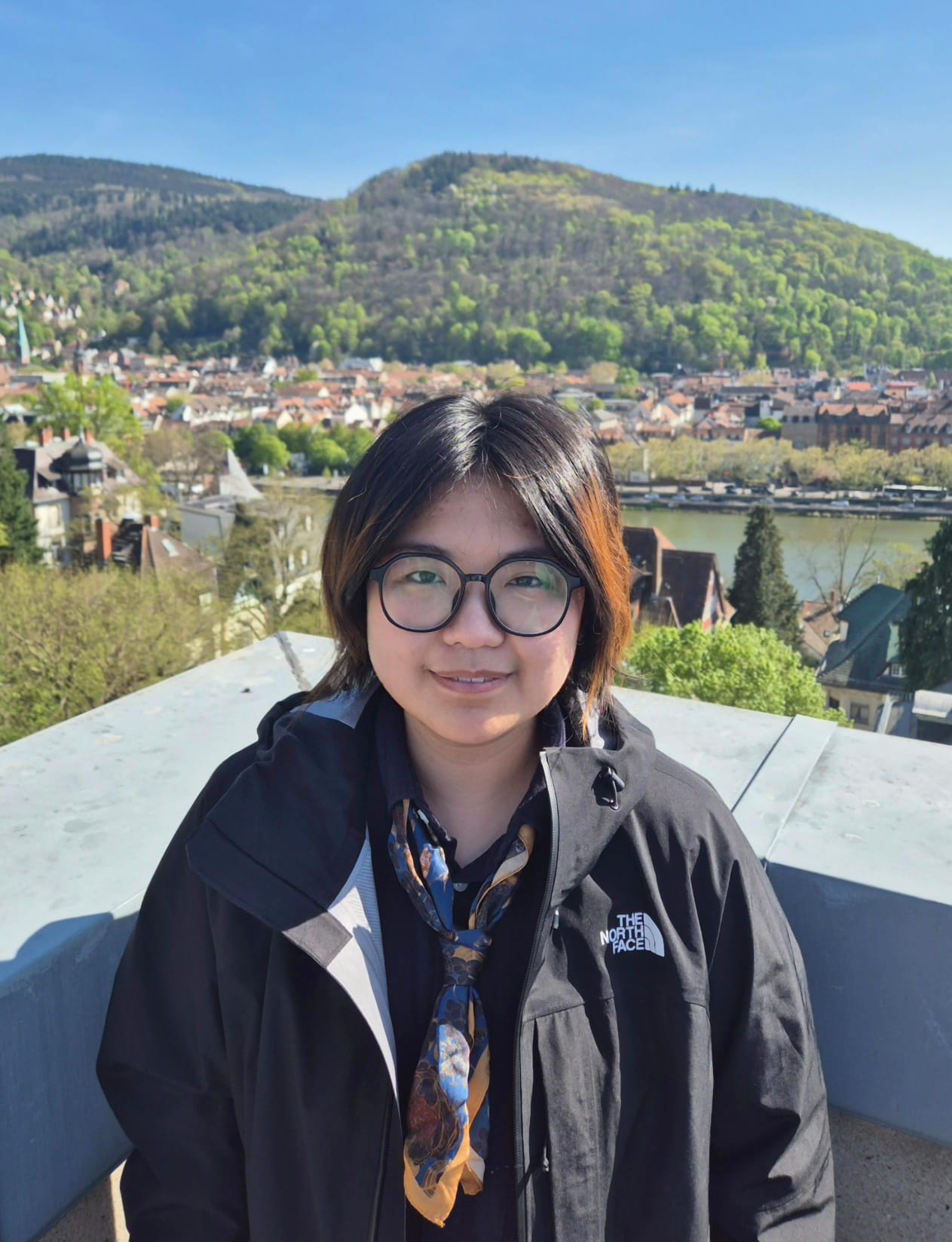
Hanqiong Jia portrait

About Me

I am an M.Sc. candidate in Physics at Ruprecht-Karls-Universität Heidelberg, working with Prof. Luca Amendola on model-independent cosmology. I build and test perturbative tools that stay accurate from the linear regime into mildly non-linear structure formation, incorporating bias, redshift-space distortions, and higher-order curvature terms.

My research spans Dark Energy/Modified Gravity, weak lensing, and high-order statistics. I am excited about confronting multi-tracer measurements with theory to stress-test the Equivalence Principle and growth of structure.

Cosmology Large-Scale Structure Perturbation Theory Multi-Tracer Analysis

Research Focus

Current projects in cosmology, gravity, and large-scale structure.

Model-Independent Methods for Testing Multiple Cosmology

We forecast constraints on \(w\)CDM and Horndeski models for DESI, Euclid, and SKA2 using a model-independent approach in the mildly non-linear regime based on standard perturbation theory.

We derive second- and third-order kernels with scale-dependent perturbation growth that include bias, redshift-space distortion effects, and higher-order curvature, all expressed in terms of the linear growing mode. The method remains valid when the \(k\)-dependent part is subdominant.
Testing the Equivalence Principle with Multi-Tracers

The Equivalence Principle has been verified with high precision for baryonic matter, but remains untested for dark matter. Violations would appear as tracer-dependent signatures in large-scale structure formation.

By measuring cross-correlations of different galaxy tracers, we aim to constrain Equivalence Principle parameters directly, without assumptions about the detailed power spectrum shape or background evolution.

Dark Energy and Galaxy Clustering from J-PAS

We present forecasts across multiple redshift bins for the Javalambre Physics of the Accelerating Universe Astrophysical Survey (J-PAS) within flat \(\Lambda\)CDM, including redshift-space distortion and Alcock–Paczynski effects.

The analysis investigates constraints on \(f\sigma_8\), \(\Omega_m\), and the growth index \(\gamma\) using three tracers: luminous red galaxies, emission line galaxies, and quasi-stellar objects.

Education

A concise timeline of my academic training.

2018–2022 · Beijing, China

Beijing Normal University

B.Sc. in Astronomy

Advisor: Bin Hu

2022–present · Heidelberg, Germany

Ruprecht-Karls-Universität Heidelberg

M.Sc. in Physics

Advisor: Luca Amendola

Publications

Peer-reviewed work and collaborations.

2021

Photometric properties of asteroid 8050 Beishida

Kelin Qiao, Jian Gao, Hanqiong Jia, Yi Ren, Tengfei Song.

Journal of Beijing Normal University (Natural Science), 57(5): 584–592.

doi:10.12202/j.0476-0301.2021046

2025

One-loop kernels in scale-dependent Horndeski theory

Ziyang Zheng, Hanqiong Jia, Bilal Tüdes, Anton Chudaykin, Martin Kunz, Luca Amendola.

Journal of Cosmology and Astroparticle Physics, 2025(11):035.

doi:10.1088/1475-7516/2025/11/035

Contact

Institut für Theoretische Physik, Philosophenweg 12, D-69120 Heidelberg, Germany